The practical takeaway
Your phone is not a moral failing, and a rigid “no screens after 8 p.m.” rule is not realistic for everyone. The useful question is simpler: what does your last stretch of screen time do to your evening? If it leaves you activated, anxious, working, or still in everyone else’s business, a few gentler boundaries can help. This fits into our broader Sleep & Recovery for Women guide and gives you a place to begin without turning bedtime into a technology cleanse.
Why the last hour can feel so sticky
The issue is not only the light from a screen. A phone can also keep the day emotionally open. A group chat becomes a work request. A short video becomes forty minutes. A headline becomes a spiral of tabs. Even a perfectly harmless show can make it harder to notice when you are actually tired.
Federal sleep guidance recommends turning off electronic devices at least 30 minutes before bedtime.[^cdc] That is a useful starting point, not a test you pass or fail. If your nights involve a late commute, caregiving, or an unpredictable schedule, build the boundary around the moment you usually shift into sleep mode rather than an idealized clock time.
Decide what your phone is allowed to do at night
“Use your phone less” is vague. A clearer approach is to choose a night role for it. Maybe it is an alarm, a place to listen to an audiobook, or a way to check one final message from family. Those are different from scrolling, answering work, or shopping in bed.
Try making a short list of what is okay after your wind-down starts. For example:
- alarm and weather check
- a calming audio track on a timer
- a short call with a person in another time zone
- an essential message from family
Everything else can wait. This gives you a boundary without pretending your phone has no place in your life.
Make the easiest choice the one you want to make
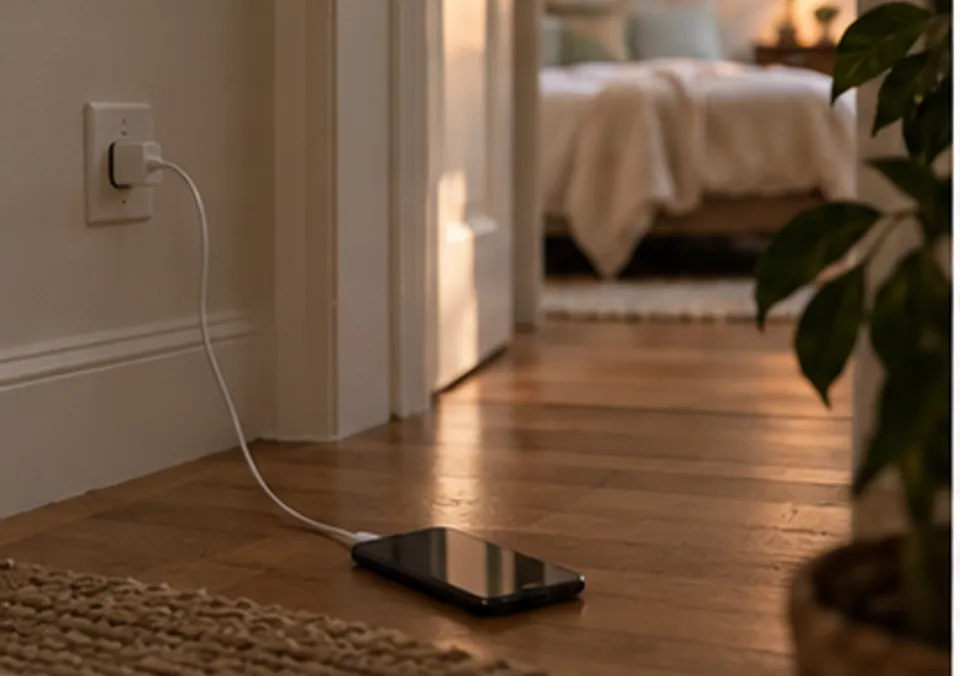
Willpower is not the best bedtime tool. Friction works better. Put your charger across the room, on a dresser, or outside the bedroom. Turn on Do Not Disturb at a set time. Remove the social apps that pull you in most from the first screen of your phone. If you use your phone as an alarm, an inexpensive alarm clock can make the charger-outside-the-bedroom option easier.
You can also make the alternative visible. Leave a book on the pillow. Put your journal and pen beside the lamp. Save a playlist or audiobook before your evening starts. The goal is not to become the kind of person who always reads at night. It is to make a lower-stimulation option as easy as reopening an app.
Try a 30-minute transition, then adjust
Start with the same 30-minute device boundary that the CDC suggests. For one week, choose a realistic trigger: after you wash your face, after you set out tomorrow’s clothes, or when your first bedtime reminder rings. You do not have to fill all 30 minutes with a wellness ritual.
One New York-friendly version could be:
- Put the phone on its charger and turn on Do Not Disturb.
- Do your normal bathroom routine in softer light.
- Spend ten minutes reading, stretching, or listening to something that does not pull for a response.
- Get into bed when you feel ready, without opening one more tab.
If 30 minutes is a genuine stretch, begin with ten. The repeatable boundary matters more than the number.
Let the bedroom be less of a feed
The National Heart, Lung, and Blood Institute recommends a quiet, cool, dark bedroom and advises avoiding electronic devices close to bedtime because the light can disrupt the sleep-wake cycle.[^nhlbi] That does not mean your bedroom must look like a hotel. It means reducing the cues that keep you in daytime mode.
Small changes can do a lot: silence notifications, hide the blinking charger light, put the laptop in another room, or use a warm bedside lamp instead of overhead light. If you live in a studio or share a room, do the best you can with what you have. A drawer, a basket, or a folded cloth over a charging area can create a useful visual boundary.
Do not replace scrolling with sleep pressure
There is a common trap in trying to improve screen habits: you put your phone away and immediately expect yourself to fall asleep. If that does not happen, the phone starts to feel like the more comfortable choice.
Instead, make the screen-free part of the evening about winding down, not forcing sleep. Read something low-stakes. Shower. Stretch gently. Put on audio with the screen facedown and a timer on. The NHLBI includes relaxing activities such as reading, soothing music, or a hot bath among habits that can help you ease into bedtime.[^nhlbi]
Your routine can be quiet without being precious. A five-minute reset is still a reset.
When evening screens are not the whole story
Screen habits are one part of sleep health. Stress, caffeine, work shifts, pain, medications, and sleep disorders can all matter too. If you regularly have trouble falling or staying asleep, wake gasping, or feel severely sleepy during the day, do not assume your phone is the only explanation. Speak with a qualified healthcare professional.
For a softer final step after you park the phone, try A Realistic Evening Routine for Better Sleep. It can help you build a simple sequence around the boundary you choose.
Sources
[^cdc]: Centers for Disease Control and Prevention. About Sleep. Reviewed May 15, 2024.
[^nhlbi]: National Heart, Lung, and Blood Institute. Insomnia Treatment. Accessed September 12, 2026.

Written by
Adele Bennett
Osavelle editorial writer, making evidence-aware wellness guidance practical for women in the United States.